Table of Contents
- Understanding Vancouver Landfill Fees in 2026
- Vancouver’s Landfill and Transfer Stations: A Fee Comparison
- How to Get Started with Your Vancouver Landfill Drop-Off
- Navigating Local Waste Disposal Rules in the Lower Mainland
- Which Transfer Station Makes Sense for Your Junk?
- Save Money and the Planet with Smart Disposal Habits
Understanding Vancouver Landfill Fees in 2026
Understanding Vancouver landfill fees 2026 is the first step to planning a junk removal project. Tipping fees—the charges applied when waste is dropped off—are determined by Metro Vancouver and are based on weight per tonne. These rates apply uniformly across all regional transfer stations and can change each year. When you compare Vancouver transfer station tipping fees and other Metro Vancouver disposal rates, it becomes clear that managing a load yourself involves more than just the advertised per-tonne cost: you also face access fees, weighing fees, and the hassle of sorting and hauling. Our team tracks these published rates so you never have to. We build the current disposal charges right into your upfront quote—giving you peace of mind with no surprises. That’s how our waste removal service delivers transparent pricing and lets you skip the scale.
Vancouver’s Landfill and Transfer Stations: A Fee Comparison
To help you understand what you might pay at public facilities, we have broken down the vancouver landfill fees 2026 at Metro Vancouver’s main disposal sites. When you compare metro vancouver disposal rates across the region, the Vancouver Landfill in Delta offers the lowest base tipping fee at $139 per tonne for mixed waste. By contrast, the City of Vancouver Transfer Station charges $145 per tonne and the North Shore Transfer Station comes in slightly lower at $142 per tonne.
These differences become even more pronounced when you factor in separate charges for specific materials. At the Vancouver Landfill in Delta, clean wood waste and yard trimmings cost $92 per tonne. The North Shore Transfer Station charges $95 per tonne for the same materials, while the City of Vancouver Transfer Station has the highest rate at $98 per tonne. Residents should also be aware that vancouver transfer station tipping fees often include additional minimum charges—$7.00 at the City facility and $8.00 at the North Shore location. A transaction fee of roughly $2 to $5 also applies to residential drop-offs at transfer stations, though it is not charged at the Vancouver Landfill itself. For mattress disposal, both the Landfill and North Shore Transfer Station levy a flat $15 fee, whereas the City Transfer Station does not charge separately for mattresses (they are disassembled instead).
What Is the Tipping Fee at the Vancouver Landfill in Delta?
The Vancouver Landfill in Delta charges a base tipping fee of $139 per tonne for mixed waste in 2026, making it the most affordable option among the three major regional facilities. This rate applies to general household refuse delivered directly to the landfill site.
Separate Fees for Wood Waste and Yard Trimmings
At the Vancouver Landfill, clean wood waste and yard trimmings cost $92 per tonne. The North Shore Transfer Station charges $95 per tonne, and the City of Vancouver Transfer Station sets its rate at $98 per tonne for the same recyclable organics.
Minimum Charges and Transaction Fees for Small Loads
For loads weighing less than one tonne, the City of Vancouver Transfer Station applies a minimum charge of $7.00. The North Shore Transfer Station sets its minimum slightly higher at $8.00. A small transaction fee is added to residential drop-offs at these transfer stations but is not collected at the Vancouver Landfill.
With these fees in mind, it is easy to see why many Vancouver residents choose eco friendly junk removal in Vancouver. Our volume-based estimates give you a transparent alternative to these variable disposal charges.
How to Get Started with Your Vancouver Landfill Drop-Off
Ready to get started? Dropping off waste at the transfer station is straightforward when you know what to expect. We’re here to help you prepare, save time, and manage your disposal costs—especially with rising Vancouver landfill fees 2026 on everyone’s mind. Let’s walk through the process step by step.
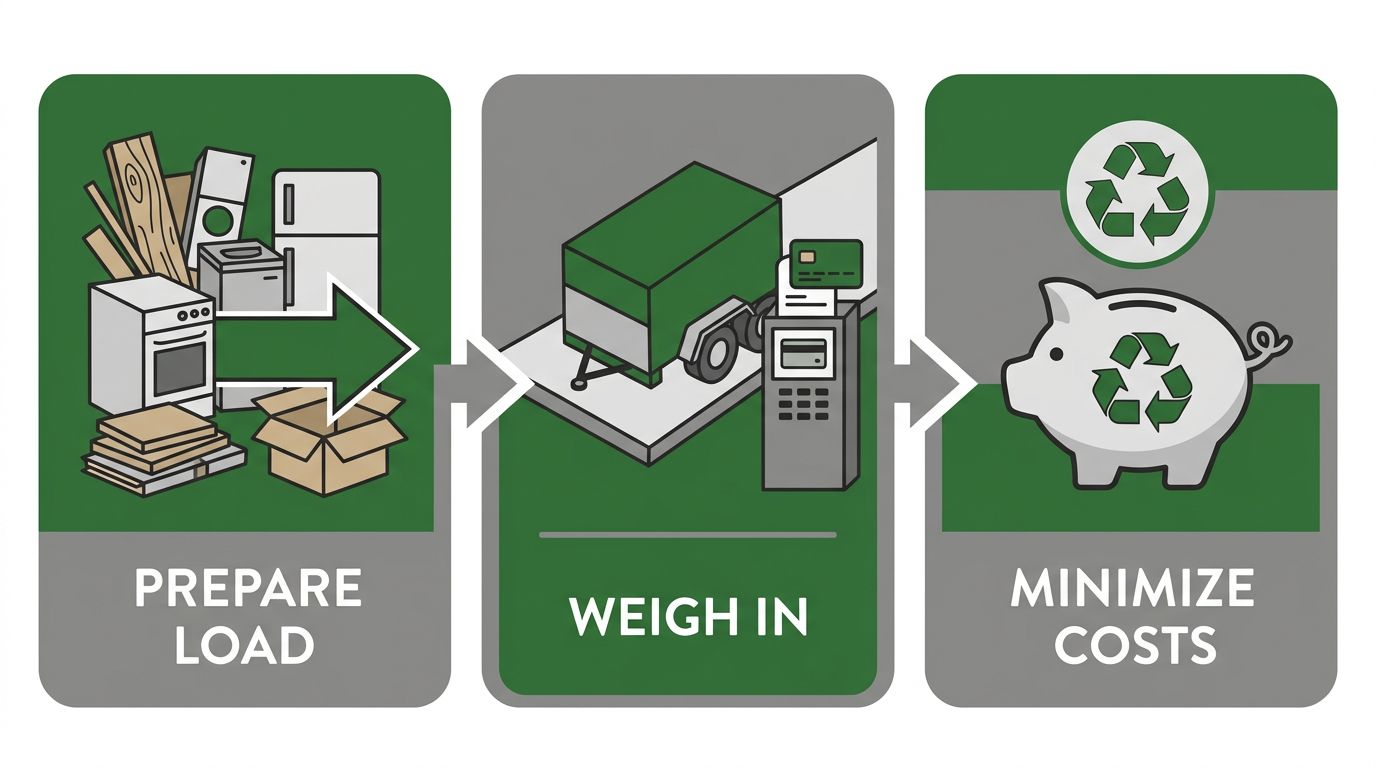
Three-step Vancouver landfill drop-off process flow.
Prepare Your Load for the Transfer Station
Before you head to the scale, separate recyclable metal and cardboard from your general waste. This simple step reduces the chargeable weight and supports better diversion. We cannot accept asbestos-containing materials, and we must remind you that unstamped drywall requires asbestos testing before disposal. Organizing your load upfront makes unloading faster and the process smoother.
Check-In, Weighing, and Payment Process
Drive your vehicle onto the scale at the scale house and let the attendant record the full incoming weight. After receiving your ticket, you’ll proceed to the active drop-off area to unload, then return across the scale to determine the net charge, which reflects current metro Vancouver disposal rates. Payment is due after the final weigh-out, and the scale house accepts cash, credit, and debit. You’ll see exactly how Vancouver transfer station tipping fees are calculated for your materials.
Tips for Minimizing Your Disposal Costs
Sorting metal and cardboard before you arrive almost always lowers your bill, because you avoid paying tip fees on materials accepted for recycling. For larger commercial loads, consider our commercial junk removal in Vancouver service for efficient handling and potential cost savings. Visiting during weekday mornings can also shorten wait times and help avoid peak-hour surcharges. Remember, our pricing is always transparent with no hidden fees, and you’ll receive a clear breakdown of your charges. Work begins only after the customer approves the provided quote. Prices and removal rates are estimates; final quotes depend on on-site assessment and customer approval. We prioritise recycling and donation but cannot guarantee 100% diversion to reuse or recycling.
Navigating Local Waste Disposal Rules in the Lower Mainland
But before you toss that old furniture, it helps to know the rules that govern disposal across the Lower Mainland. While Vancouver landfill fees 2026 may be on your mind, the real challenge is navigating the patchwork of local regulations that vary by municipality. As a locally owned service founded in 1998, we help customers make sense of these requirements every day.
Accepted and Prohibited Waste Types
General landfills in the region accept common household waste, but many everyday items are banned outright. Electronics, hazardous liquids, paints, and chemicals cannot go into standard trash and require separate diversion. According to our internal support resources, knowing these prohibited categories before you load the truck saves time and avoids rejected loads at the gate.
Construction Debris and Demolition Waste Regulations
Construction and demolition debris is governed by stricter rules in Metro Vancouver. Materials like drywall, concrete, and lumber often require drop-off at designated facilities, and unstamped drywall needs asbestos testing before disposal. We do not handle asbestos-containing materials, but our team can guide you through the requirements so your project stays compliant without unnecessary delays.
Municipal Rules and Recycling Programs
Each city maintains its own recycling schedules and curbside rules, which directly influence what you can set at the curb versus what needs professional hauling. Vancouver’s Green Bin program and Surrey’s pickup calendars shape what items must be handled separately, and metro vancouver disposal rates and Vancouver transfer station tipping fees reflect these sorting mandates. We love junk, but we love keeping things simple and transparent even more—our no hidden fees approach means you receive a clear quote after we understand what you need hauled, so there are never surprises at pickup.
Our three-step process turns regulatory confusion into predictable, eco-friendly disposal—giving you peace of mind, one piece at a time.
Which Transfer Station Makes Sense for Your Junk?
Understanding your disposal options in Metro Vancouver starts with knowing the latest costs and facility choices. With vancouver landfill fees 2026 updates potentially shifting the economics of disposal, it pays to know which transfer station best fits your load, your location, and your budget.
City of Vancouver Transfer Station vs. Other Facilities
If your load is mostly general household waste, the City of Vancouver Transfer Station offers a straightforward, central option for Vancouver residents. However, vancouver transfer station tipping fees can add up quickly for heavier loads, and the vancouver landfill fees 2026 rate card may influence your bottom line. When you have a mix of metal, cardboard, or reusable furniture, we often recommend a waterfront facility or a dedicated recycling centre. These sites can sometimes offer lower disposal costs for diverted materials, helping you keep more money in your pocket while doing right by the environment.
Commercial vs. Residential Drop-Off Considerations
Commercial accounts unlock volume-based pricing advantages at many regional facilities. If you are managing a large office cleanout, a renovation, or a construction project, the per-tonne metro vancouver disposal rates often favor commercial loads over multiple residential trips. Residential drop-off is typically simple to arrange, but size and weight limits can surprise first-timers. Before you load up your truck or trailer, we recommend checking the current tipping fees and posted rules for your intended facility. For the most accurate pricing, snap a photo of your pile and call the station directly; published facility fees can shift, and seasonal surcharges can sometimes apply.
Choosing the Right Facility for Your Location
Where you live should shape your facility choice. For Vancouver residents, the City of Vancouver Transfer Station is the closest physical option. Richmond residents often save time by heading to a central or south-side facility. In Burnaby and Coquitlam, the Coquitlam Transfer Station provides a practical stop for most loads. Surrey residents will find the Surrey Transfer Station the most accessible route. No matter where you start, always verify operating hours and current tipping fees online before you head out; a quick check can save a wasted trip.
Save Money and the Planet with Smart Disposal Habits
With Vancouver landfill fees set for 2026, now is the perfect time to rethink how you get rid of unwanted items. Smart disposal habits line your pockets and lighten your footprint. Understanding the full Vancouver junk disposal cost overview helps you see how much you can save by choosing eco-friendly alternatives.
Tipping fees at transfer stations are rising, but donating reusable furniture or recycling metals and cardboard can cost you nothing — especially since we collect those materials at no charge. When you factor in Metro Vancouver disposal rates for multiple trips, a single visit from our team often works out far cheaper.
Call us for a FREE QUOTE — and start saving money while helping the planet. We give you peace of mind, one piece at a time.
Resources
- Get Eco-Friendly Recyclable Waste Removal in Vancouver
- Find Sustainable Junk Removal Services in Vancouver
- Get Professional Commercial Junk Removal in Vancouver
- Find Comprehensive Commercial Waste Removal in Vancouver
- Get Eco-Friendly Junk Removal in Greater Vancouver
- Schedule Commercial Junk Removal in Vancouver Easily
- Get Compliant Commercial Waste Removal in Vancouver
- Find Official Junk Disposal Costs in Vancouver